Key Takeaways
- Electric arc welding uses an electric arc between an electrode and the base metal to generate enough heat to melt and fuse metal together.
- It’s not one single process — MIG, TIG, stick, and flux-core welding are all forms of arc welding, just with different equipment and electrode types.
- “Electric arc welding” is sometimes used informally to mean stick welding (SMAW) specifically, which causes confusion when comparing it to MIG.
- TIG welding is generally considered the hardest arc welding process to learn because of the coordination it demands.
- Choosing between arc welding types comes down to material, thickness, and how much precision the job actually needs.
What Is Electric Arc Welding?
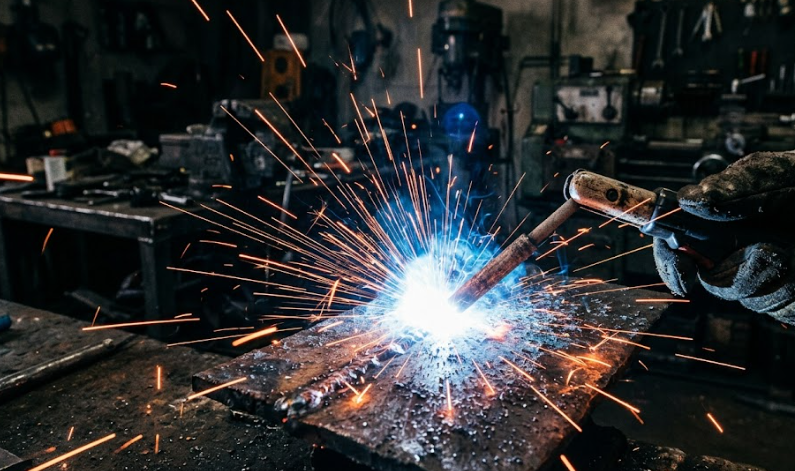
Electric arc welding is a welding process that uses an electric arc — a sustained electrical discharge between an electrode and the base metal — to generate enough heat to melt the metal and fuse a joint, often with a filler material added to strengthen the connection. The “arc” itself can reach temperatures well over 6,000°F, hot enough to melt steel almost instantly at the point of contact. This is the foundation underneath most modern welding processes, including MIG, TIG, stick, and flux-core welding — they’re all variations on the same basic electric arc principle.
Why It Matters Right Now
A lot of beginner confusion starts right here, with the term itself. Someone searching “electric arc welding” is often picturing stick welding specifically — the process most people learn first in shop class — without realizing that MIG and TIG welding are technically arc welding too. Understanding that arc welding is the umbrella category, not a single process, makes every other welding decision easier, since it reframes the choice as “which type of arc welding” rather than “arc welding vs. something else.”
How Electric Arc Welding Works
The basic mechanism is the same across every arc welding type: electrical current flows from the welding machine through the electrode, jumps across a small gap to the base metal as an arc, and that arc generates intense, localized heat. The heat melts both the base metal and the electrode (or filler wire), and as the molten metal cools, it solidifies into a fused joint.
What changes between processes is how the electrode is delivered, whether it’s consumable or non-consumable, and how the weld area is protected from atmospheric contamination during the melt.
The Four Types of Arc Welding
SMAW (Shielded Metal Arc Welding / Stick Welding)
Uses a flux-coated consumable electrode rod. The flux coating burns off during welding and creates its own protective gas shield, which makes stick welding well suited to outdoor or windy conditions where shielding gas would blow away.
GMAW (Gas Metal Arc Welding / MIG Welding)
Feeds a continuous solid wire electrode through a gun, shielded by an externally supplied gas. This is the fastest and most beginner-friendly arc welding process for general fabrication work.
GTAW (Gas Tungsten Arc Welding / TIG Welding)
Uses a non-consumable tungsten electrode and a separately fed filler rod, shielded by inert gas. It offers the most control and the cleanest welds, especially on thin metal and aluminum.
FCAW (Flux-Cored Arc Welding)
Similar in setup to MIG, but uses a tubular wire filled with flux instead of solid wire, which can eliminate the need for external shielding gas depending on the wire type. This makes it popular for thicker material and outdoor or windy job sites.
Electric Arc Welding vs. MIG Welding
This comparison only makes sense once the terminology is clear: MIG welding is a type of electric arc welding, not a separate category competing against it. When people ask whether “electric arc welding” is better than MIG, they’re usually comparing stick welding (SMAW) to MIG specifically.
Stick welding is more portable, works well outdoors, and handles rusty or dirty material more forgivingly, but it’s slower and produces more spatter and slag that needs to be chipped away. MIG welding is faster, cleaner, and easier for beginners to learn, but it’s less practical outdoors or in windy conditions since the shielding gas can blow away from the weld.
Which Arc Welding Process Is Hardest to Learn
TIG welding is widely considered the hardest of the four to learn well. It requires coordinating a torch in one hand and a filler rod in the other, often while managing a foot pedal for heat control, and the margin for error on technique is much tighter than with MIG or stick welding. Stick welding has its own learning curve around striking and maintaining a consistent arc, but most people pick up MIG welding fastest of the four.
Common Mistakes When Learning Arc Welding
- Confusing “arc welding” with one specific process — leads to comparisons that don’t actually make sense, like asking if arc welding is “better” than MIG when MIG is arc welding.
- Starting with TIG before building basic arc fundamentals — the steeper coordination demands of TIG are much harder to learn first compared to starting with MIG or stick.
- Using the wrong electrode or wire type for the job — flux-core wire on indoor precision work, or solid MIG wire outdoors in wind, both lead to poor results that have nothing to do with skill.
- Underestimating how much shielding matters — wind disrupting MIG’s gas shield is one of the most common causes of porosity for beginners welding outdoors.
- Skipping proper PPE because the arc “doesn’t look that bright” — every arc welding type produces enough UV radiation to cause arc eye, regardless of how intense the visible light appears.
Wrapping Up
Electric arc welding isn’t a single process — it’s the umbrella term covering MIG, TIG, stick, and flux-core welding, all of which use the same basic electric arc to melt and fuse metal. Once that distinction is clear, choosing the right process for a job becomes a much more straightforward decision based on material, thickness, and working conditions rather than a vague comparison between “arc welding” and everything else.
Frequently Asked Questions
What do you mean by electric arc welding?
Electric arc welding refers to any welding process that uses an electric arc between an electrode and the base metal to generate the heat needed to melt and fuse metal. MIG, TIG, stick, and flux-core welding are all specific types of electric arc welding rather than separate, competing processes.
Why do welders not live long?
There’s no solid evidence that welding itself shortens life expectancy. The real long-term risks come from fume inhalation and UV exposure when proper safety equipment isn’t used consistently, and welders who use respirators, ventilation, and correct PPE largely avoid the long-term health effects this myth is based on.
What are the four types of arc welding?
The four main types are SMAW (stick welding), GMAW (MIG welding), GTAW (TIG welding), and FCAW (flux-cored arc welding). Each uses a different electrode setup and shielding method, making them suited to different materials and working conditions.
Is electric arc welding better than MIG welding?
This comparison is a bit of a misnomer, since MIG welding is itself a type of electric arc welding. What people usually mean is stick welding versus MIG: stick is more portable and forgiving on dirty or rusty material, while MIG is faster, cleaner, and generally easier for beginners.
What is the hardest welding to learn?
TIG welding is generally considered the hardest of the common arc welding processes, since it requires coordinating a torch, filler rod, and often a foot pedal at the same time with very little margin for error. Most people find it easier to learn after building fundamentals on MIG or stick welding first.