Key Takeaways
- Every beginner needs an auto-darkening helmet — the speed difference between an auto-darkening lens and a fixed-shade flip helmet is exactly the gap between protecting your eyes and not.
- ANSI Z87.1 certification is the baseline safety requirement for any welding helmet sold in the United States — don’t buy one without it.
- Harbor Freight helmets are ANSI certified and work for occasional hobby use, but the optics clarity, headgear comfort, and sensor reliability consistently improve as you spend more.
- The YESWELDER LYG-M800H is the strongest all-around budget pick at around $50–$70, while the Lincoln Electric Viking 3350 is the benchmark for anyone who wants to buy once and not upgrade.
- Arc eye (photokeratitis) is the most common welding eye injury — it’s painful, avoidable, and the direct result of using inadequate or incorrect shade protection.
Why the Welding Helmet Is the Most Important Safety Purchase a Beginner Makes
A MIG welder produces intense UV and infrared radiation from the exact instant the arc strikes — not after a moment, not gradually, immediately. Without a properly darkened lens already in position at that instant, arc flash occurs. This isn’t a near-miss; it’s the standard consequence of unprotected exposure. For a beginner still learning to strike a consistent arc and developing the muscle memory to position the gun before pulling the trigger, this matters more, not less, than for an experienced welder. The helmet is not an accessory — it’s the most critical piece of equipment in the entire setup.
Why Do Welders Lose Their Eyesight?
Most welding eye damage falls into two categories, and both are directly tied to protection choices rather than welding itself.
Arc eye (photokeratitis) is the most common injury — a UV-induced corneal burn that develops within hours of exposure and feels like severe grit under the eyelids. It typically resolves within 24–48 hours but is genuinely painful and temporarily impairs vision during recovery. It can occur from reflected arc flash, not just direct exposure, which is why bystanders in a welding area also need protection.
Long-term damage — repeated or prolonged unprotected UV exposure accumulates over years, contributing to accelerated cataract formation. Welders who use a properly shaded, certified helmet consistently throughout their career don’t develop the chronic exposure that produces long-term outcomes.
Both categories trace to the same root: wrong shade, missing protection, or a helmet that fails to darken correctly. A properly certified auto-darkening helmet with the right shade range for the process being used addresses both risks at once.
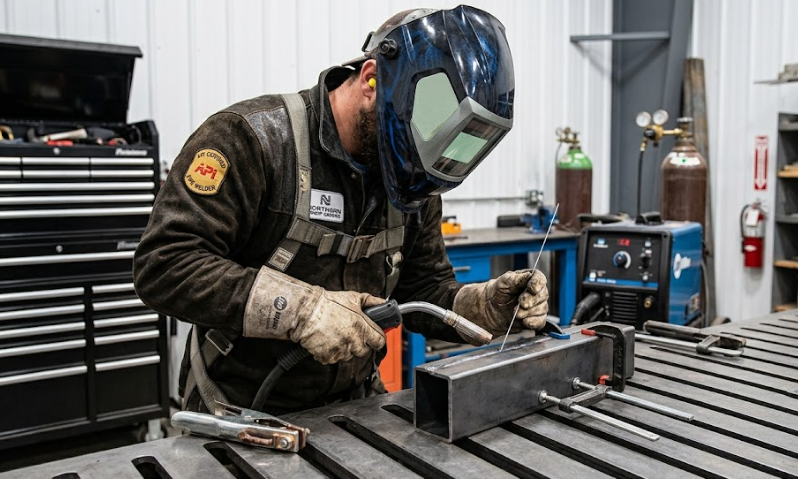
How Do I Choose a Welding Helmet?
For a beginner, five features actually matter — everything else is noise at this stage:
ANSI Z87.1 Certification
This is the minimum US safety standard for welding helmets. Every helmet on this list carries it. Don’t purchase one that doesn’t.
Auto-Darkening Lens
Fixed-shade “flip” helmets require you to nod your head to flip the lens down before striking an arc — a skill that takes practice and produces arc flash when timing is off. Auto-darkening helmets darken in fractions of a millisecond when the arc strikes, removing that timing variable entirely. For beginners, auto-darkening is the choice that removes a common cause of early eye injuries.
Shade Range
For most beginner MIG and stick welding at 60–200A, a shade range of 9–13 covers the work. Confirm the minimum shade isn’t too dark for the low-amperage TIG work many beginners eventually try.
Sensor Count
Two-sensor helmets can fail to darken if one sensor is blocked by an arm or part of a fixture. Four-sensor helmets provide backup coverage that matters more than most beginners expect on real jobs.
Switching Speed
1/10,000 second is the standard speed on most auto-darkening helmets and is adequate for MIG and stick welding. Faster speeds matter more for TIG at very low amperage — not a beginner concern.
What Is the Best Entry Level Welder Helmet?
YESWELDER LYG-M800H — Best Overall Budget Pick
The strongest all-around beginner value, offering the largest viewing area among commonly reviewed budget helmets at 14.5 square inches, four arc sensors, and a dual shade range covering both grinding mode and standard welding. Four-sensor coverage at a budget price point is the key advantage here — most competing helmets at similar prices use two sensors. At around $50–$70, it consistently outperforms its price in verified buyer reviews for clarity and coverage.
Lincoln Electric Viking 3350 — Best Buy-Once Helmet
If you know you’re going to stick with welding and don’t want to upgrade in six months, the Viking 3350 is the professional benchmark that every independent review treats as the standard to compare against. Four sensors, exceptional clarity, and consistent performance that holds up to daily use. The higher price is the only genuine barrier for absolute beginners.
ESAB Sentinel — Best for Long-Session Comfort
If the helmet is going on your head for hours at a time on larger projects, the ESAB Sentinel’s padding and headgear design consistently get called out in long-wear reviews as meaningfully more comfortable than most alternatives. Comfort matters more than most beginners anticipate before their first long welding session.
Miller Digital Elite — Best for Outdoor Welding
For anyone welding outside regularly, Miller’s X-Mode uses electromagnetic rather than light-based arc detection, eliminating the false-trigger problem that affects standard auto-darkening helmets in direct sunlight. For outdoor work specifically, this feature moves from “nice to have” to “genuinely important for eye protection.”
Are Harbor Freight Welding Helmets Good?
The honest answer has two parts and both are true simultaneously.
Harbor Freight’s welding helmets — primarily the Vulcan and Titanium lines — are ANSI Z87.1 certified, which means they meet the minimum safety standard for welding in the United States. Multiple experienced welders report using them successfully for years of hobby and occasional shop use. For the $49–$169 price range Harbor Freight covers, they represent real value for a beginner testing whether welding is going to stick before committing to a premium helmet.
The limitations show up consistently in the same places across reviews: brighter, clearer optics in mid-range and professional helmets; better headgear comfort and adjustability above the budget tier; and occasional sensor reliability issues — particularly the false-triggering in sunlight that bothers welders doing outdoor work. One welder described it bluntly: Harbor Freight helmets work, but you’ll find brighter viewing, better sensitivity control, and a more comfortable headband as you spend more.
For a beginner welding indoors on a standard hobby setup: a Harbor Freight helmet is a reasonable starting point, especially with a coupon. For someone committing to regular welding immediately: spending $50–$70 on the YESWELDER gets you four sensors and meaningfully better optics without a large price jump.
What Is the Best Budget Welding Helmet?
The YESWELDER LYG-M800H is the most consistently recommended budget pick for beginners wanting the best protection and viewing area per dollar spent, specifically because it includes four arc sensors at a price where most competitors offer only two. The one caveat consistently mentioned in reviews is long-term durability data — YESWELDER is a newer brand without the multi-decade track record of Miller or Lincoln.
If brand track record matters more than maximizing features per dollar, the Lincoln Electric K3034-4 Auto-Darkening Welding Helmet sits in a similar price range with Lincoln’s established reliability behind it — fewer features than the YESWELDER at a similar or slightly higher price, but with a longer brand track record for the buyer who weights that highly.
How to Choose a Beginner Welding Helmet: Step-by-Step
- Confirm ANSI Z87.1 certification before anything else. This is the floor, not a selling point — it should appear on every helmet you consider.
- Choose auto-darkening, not fixed shade. The timing variable fixed helmets require is a common source of early arc flash injuries for beginners still developing technique.
- Prioritize four sensors over two. The price difference at the budget tier is small; the coverage difference is real.
- Check the shade range covers your process. For MIG and stick welding at normal beginner amperage, a shade 9–13 range is standard.
- Try the helmet on if possible. Headgear fit varies significantly between helmets and heads — comfort matters more than it sounds for anything longer than 20-minute sessions.
Common Mistakes When Buying a First Welding Helmet
- Buying the cheapest available without checking certification — uncertified helmets may appear to darken without providing adequate UV and IR filtration.
- Choosing a fixed-shade helmet to save money — the timing skill required is an unnecessary beginner hazard that auto-darkening eliminates at a modest price premium.
- Assuming Harbor Freight is unsafe — their certified helmets meet ANSI standards and work for hobby use; the limitations are in optics clarity and comfort, not fundamental eye protection.
- Ignoring sensor count at the budget tier — the upgrade from two to four sensors for a small price difference is one of the most worthwhile beginner upgrades available.
- Planning to upgrade soon anyway, so buying the cheapest possible now — the price gap between the cheapest option and a significantly better beginner option is small enough that it’s rarely worth multiple purchases.
Wrapping Up
The best beginner welding helmet is an auto-darkening helmet with ANSI Z87.1 certification and four arc sensors — everything else in the decision is secondary. Harbor Freight’s certified options work for occasional hobby use; the YESWELDER LYG-M800H gives you four sensors and better optics for a modest step up in price; and the Lincoln Viking 3350 is there when you’re ready to buy once and be done. Don’t compromise on certification and auto-darkening; everything else has reasonable budget options available.
Frequently Asked Questions
Why do welders lose their eyesight?
Most welding eye damage is arc eye (photokeratitis) — a painful UV corneal burn caused by flash exposure. Long-term, repeated unprotected exposure can contribute to cataracts. Both trace directly to inadequate or incorrect shade protection rather than welding itself.
How do I choose a welding helmet?
For beginners, prioritize ANSI Z87.1 certification, an auto-darkening lens, four arc sensors, a shade range of 9–13 for standard MIG and stick work, and a comfortable headgear fit — in roughly that order of importance.
What is the best entry level welder helmet?
The YESWELDER LYG-M800H is the strongest all-around budget pick for most beginners, offering four arc sensors and the largest viewing area at its price point. The Lincoln Electric Viking 3350 is the buy-once benchmark for anyone committing to regular welding immediately.
Are Harbor Freight welding helmets good?
Their ANSI-certified Vulcan and Titanium lines are genuine options for hobby and occasional use — they meet the safety standard and work as described. The consistent limitations compared to mid-range helmets are optical clarity, headgear comfort, and sensitivity control, not fundamental eye protection for indoor hobby welding.
What is the best budget welding helmet?
The YESWELDER LYG-M800H consistently tops budget helmet comparisons for its four-sensor coverage, large viewing area, and price point around $50–$70, making it the recommended starting point for most beginners who want better than entry-level without the professional price.