Key Takeaways
- Welding metallurgy is the study of how heat changes a metal’s internal structure during and after welding, not just how the joint looks on the surface.
- Every weld creates three distinct zones: the fusion zone (melted), the heat-affected zone (HAZ), and the unaffected base metal — and the HAZ is usually where problems start.
- The classic five fundamentals of welding — electrode size, current, arc length, travel speed, and electrode angle — control how much heat goes into the joint and how it cools.
- High-carbon metals like cast iron are harder to weld because rapid heating and cooling encourages brittle microstructures right at the HAZ.
- Preheat and controlled cooling exist specifically to manage the metallurgical changes that cause cracking, not just to make the welding process easier.
What Is Welding Metallurgy?
Welding metallurgy is the study of how heat from the welding process changes a metal’s internal grain structure, hardness, and mechanical properties, both in the weld itself and in the surrounding base metal. It matters because a weld that looks perfect on the surface can still fail if the underlying metallurgy created a brittle zone or excessive residual stress. Understanding the basics helps explain why some metals weld easily and others, like cast iron or high-carbon steel, require careful preheat and cooling control to avoid cracking.
Why It Matters Right Now
Most weld failures that don’t trace back to obvious technique errors trace back to metallurgy. A joint that cracks days or weeks after welding, with no obvious cause, is often a metallurgical problem — hydrogen trapped in the weld, a hard and brittle heat-affected zone, or residual stress that finally exceeded the material’s limit. Understanding what’s happening beneath the surface during welding is what separates troubleshooting a real cause from guessing.
What Happens to Metal During Welding
Every weld creates three distinct zones, each with different metallurgical behavior.
Fusion Zone
The area that actually melted and resolidified, mixing base metal and filler metal together. This zone has a cast-like grain structure since it cooled from a fully molten state.
Heat-Affected Zone (HAZ)
The metal right next to the fusion zone that got hot enough to change its grain structure without actually melting. This is where most metallurgical problems occur, since the rapid heating and cooling can dramatically alter the metal’s hardness and ductility.
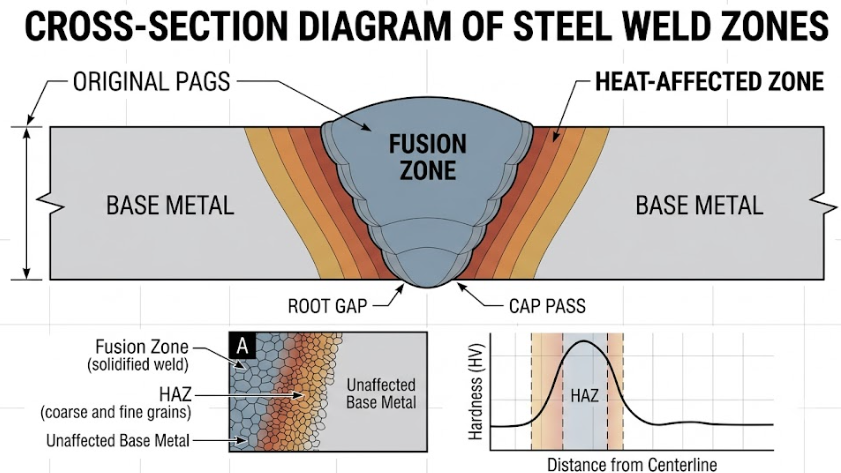
Base Metal
The unaffected material beyond the HAZ, which retains its original grain structure and properties.
Why the Heat-Affected Zone Matters
In carbon steel, the HAZ is where rapid cooling can transform the metal’s microstructure from a relatively soft, ductile form into a much harder, more brittle one — similar in principle to how quenching steel in heat treatment produces hardness. If that transformation happens too aggressively right next to a weld, the HAZ becomes a brittle zone prone to cracking under stress, even though the weld metal itself looks fine.
This is exactly why preheat matters so much on certain materials. Slowing down the heating and cooling rate gives the HAZ time to form a less brittle structure, instead of the hard, crack-prone structure that rapid cooling produces.
Common Metallurgical Problems in Welding
Hydrogen Cracking
Hydrogen from moisture, rust, or contaminated electrodes can become trapped in the weld and HAZ, creating cracks hours or days after welding — often called “delayed cracking.”
Hot Cracking
Occurs while the weld metal is still solidifying, often caused by impurities like sulfur or excessive dilution from the base metal that lower the solidification temperature range in a way that promotes cracking.
Excessive HAZ Hardness
Common on higher-carbon steels and cast iron, where rapid cooling transforms the HAZ into a hard, brittle structure that cracks under stress that the rest of the joint could easily handle.
Residual Stress and Distortion
Uneven heating and cooling across a weldment creates internal stress that can warp parts or, combined with a brittle zone, contribute to cracking well after the weld is complete.
Carbon Content and Weldability
The more carbon a metal contains, the more dramatically its microstructure can change in the HAZ under rapid heating and cooling, which is why high-carbon steels and cast iron are considered harder to weld than mild steel. Welding engineers often use a carbon equivalent formula, factoring in carbon plus other alloying elements like manganese, chromium, and nickel, to estimate how prone a given steel is to HAZ cracking and whether preheat is needed before welding.
This is also the metallurgical reason cast iron repairs lean so heavily on preheat, slow cooling, and sometimes nickel-based filler rather than standard mild steel rod — the goal is managing exactly the kind of brittle transformation described above.
The 5 Fundamentals That Control Weld Metallurgy
Beyond material selection, the classic five essentials of welding directly control how much heat goes into a joint and how it cools, which is the core variable in weld metallurgy.
- Electrode Size — affects deposition rate and heat input for a given amperage.
- Current — the primary driver of heat input and penetration depth.
- Arc Length — too long an arc spreads heat and increases spatter; too short risks sticking and uneven fusion.
- Travel Speed — directly affects how much heat accumulates in a given area of the joint.
- Electrode Angle — influences penetration pattern and how heat distributes through the joint.
Common Mistakes That Lead to Metallurgical Problems
- Skipping preheat on high-carbon or cast iron material — the single most common cause of HAZ cracking on these metals.
- Welding over rust, oil, or moisture — introduces hydrogen that can cause delayed cracking well after the weld looks finished.
- Cooling a weld too quickly — quenching or rapid air-cooling on crack-prone materials undoes the benefit of careful preheat.
- Ignoring travel speed as a heat input factor — welders often adjust voltage and wire feed speed without realizing travel speed changes heat input just as much.
- Assuming a clean-looking weld means a sound one — surface appearance says nothing about hidden HAZ hardness or trapped hydrogen.
Wrapping Up
Welding metallurgy comes down to understanding that every weld creates three zones, and the heat-affected zone is usually where hidden problems start. Controlling heat input through the five fundamentals, using preheat where the material demands it, and respecting carbon content’s effect on weldability are what separate a weld that holds from one that fails weeks later for reasons that were never visible on the surface.
Frequently Asked Questions
What is the basic welding metallurgy?
Welding metallurgy is the study of how heat from welding changes a metal’s grain structure and properties, both in the weld itself and in the surrounding heat-affected zone. It explains why some welds fail metallurgically even when they look structurally sound on the surface.
What are the 5 fundamentals of welding?
The classic five essentials, historically taught for stick welding but broadly applicable, are electrode size, current, arc length, travel speed, and electrode angle. Together, these control how much heat enters the joint and how that heat is distributed, which directly affects the resulting metallurgy.
Why do welders drink milk after welding?
This comes from a long-standing shop myth tied to welding galvanized steel, which releases zinc oxide fumes that can cause metal fume fever. There’s no solid medical evidence that milk prevents or treats this — proper ventilation and a respirator are the actual ways to avoid the problem.
Can you make $100,000 as a welder?
Yes, this is realistic in several specialties. Pipeline welders in oil-producing regions can reach $72,000–$135,000 in the top 10%, certified welding inspectors often earn $70,000–$110,000, and union membership alone adds a 25–40% pay premium. It generally requires stacking certifications or specializing rather than relying on general welding experience alone. Bestjobsearchapps
Why do welders not live long?
There’s no solid evidence that welding itself shortens life expectancy. The long-term risks come from fume and UV exposure when proper safety equipment isn’t used consistently, and welders who use respirators, ventilation, and correct PPE largely avoid the health effects this myth is based on.