
Welding gear varies widely—but for pipeline welders and outdoor professionals, a pancake welding hood stands out. Engineered to offer unmatched glare protection, lightweight comfort, and field-ready durability, this helmet-style hood is uniquely suited for challenging welding environments.
What Is a Pancake Welding Hood?
A pancake welding hood is a specialized type of welding helmet designed primarily for outdoor and pipeline welding. It features a flat, round face shield—resembling a pancake—and a built-in balsa wood box that fits snugly around the eyes and nose to block out sunlight and glare. This unique design helps welders maintain a clear view of the weld, especially in bright, open environments. Typically lightweight and custom-fitted to the welder’s face, pancake hoods offer excellent comfort during long work hours and come in right- or left-handed versions to protect the welder’s dominant side.
Why the name “pancake”?
A pancake hood earns its nick-name due to its flat, round front plate that resembles a pancake. Unlike bulky helmets, it has a slim profile that allows close vision and minimal neck strain.
The balsa box – custom fit and glare control
A balsa wood box around the viewing lens is shaped to fit a welder’s facial contours. Sandable and soft, it seals out backlight and glare, even when welding with the sun behind you.
Key Benefits of a Pancake Welding Hood
Pancake Welding Hood Is Lightweight & ultra-comfortable
Most pancake welding hoods weigh between 9–12 ounces (roughly half a pound), making them significantly lighter than traditional pipeliner or flip-up welding helmets. This ultra-lightweight design reduces strain on the neck and shoulders, especially during extended welding sessions. Welders working in overhead or awkward positions—common in pipeline environments—benefit from less physical fatigue. The pancake welding hood stands out among gear options due to its extremely low weight nature also makes it easier to transport, store, and wear in remote or rugged job sites where gear needs to be both tough and portable.
Glare protection in bright outdoor conditions
The defining feature of the pancake welding hood is its balsa wood eye box, which creates a tight facial seal to block sunlight, backlight, and ambient glare. This makes it ideal for outdoor welding, where sun exposure can severely impact visibility and weld quality. Unlike standard hoods that let in light from the sides or back, pancake welding hoods provide a shadowed, controlled viewing tunnel that enhances clarity and contrast at the arc. Whether you’re welding in desert heat, open fields, or bright rooftops, this design keeps your sightline crisp and consistent.
Protection against sparks, UV, and IR exposure
Equipped with a side shield aligned with your non-dominant side, pancake hoods prevent hot sparks and slag from hitting exposed skin. Combined with ANSI-rated lenses, they effectively filter ultraviolet (UV) and infrared (IR) rays emitted during arc welding, minimizing long-term eye damage and facial burns. The secure fit also helps reduce dust and fume exposure in windy outdoor settings. This safety-first design is crucial for meeting both OSHA standards and jobsite safety protocols in pipeline, structural, and industrial welding applications.
Excellent ventilation and ergonomic design
Unlike fully enclosed welding helmets, pancake hoods are built for breathability. The open-side design allows air to flow naturally across your face and neck, preventing excessive sweat build-up—especially in hot or humid climates. The adjustable elastic or ratcheting headband ensures a balanced, secure fit without pressure points. The overall ergonomic profile supports long hours of continuous welding, allowing the welder to stay focused without constant repositioning or discomfort.
Customizable for personal fit and performance
One often-overlooked benefit is how customizable pancake hoods are. The balsa box can be sanded down to match your facial structure perfectly, providing a seal that feels almost molded to your face. This not only improves comfort but also increases light-blocking efficiency. Many models are also compatible with both passive and auto-darkening lenses, giving welders the freedom to match their hood to their visual preferences and work type.
Drawbacks and Limitations
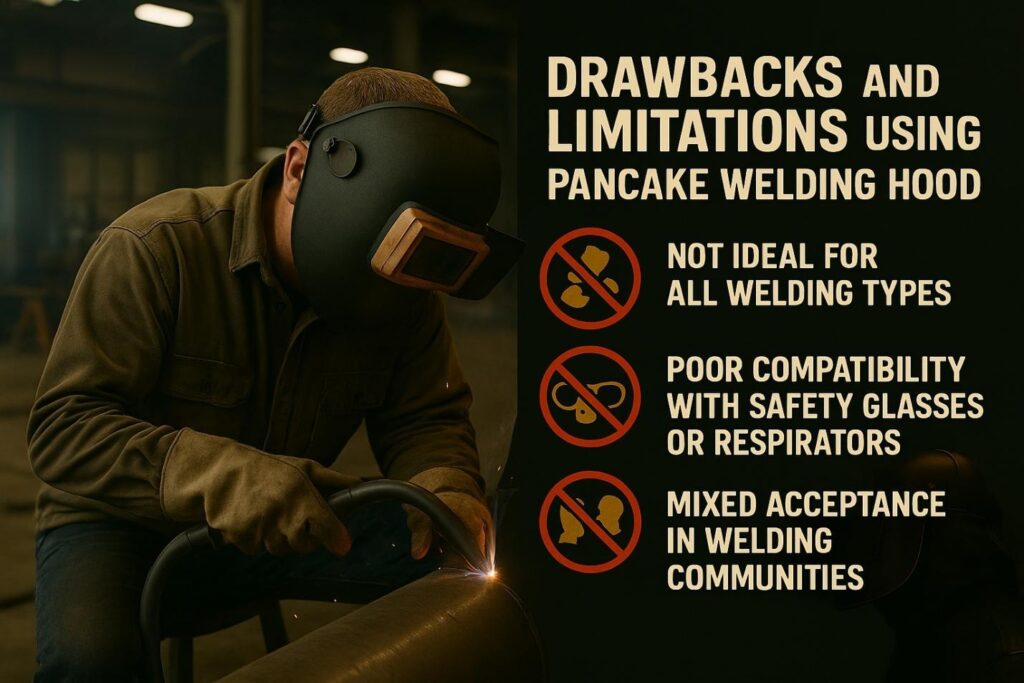
Not ideal for all welding types
While the pancake welding hood is excellent for pipeline and outdoor fieldwork, it’s not well-suited for all welding environments. For shop-based fabrication, structural work, or multi-process stations, its fixed-lens and non-flip-up design can become a limitation. Welders who need to frequently inspect their welds, switch between grinding and welding, or work in confined indoor areas may find it less convenient compared to modern flip-up or auto-darkening hoods. Additionally, its narrow field of vision can be restrictive during tasks that require broad situational awareness or precise alignment work.
Poor compatibility with safety glasses or respirators
The tight seal of the balsa wood box, while excellent for blocking light, leaves minimal clearance inside the hood. This often creates problems for welders who wear prescription glasses, safety goggles, or half-face respirators. Most standard eyewear doesn’t fit inside the balsa box, forcing welders to choose between modifying their gear or sacrificing protection. Although some experienced users create custom notches or widen the box opening, this compromises the light seal and may void warranty or safety certifications. For welders who require respiratory protection or corrective lenses, a pancake hood can be impractical without significant adjustment.
Mixed acceptance in welding communities
Despite its proven benefits in the pipeline and field welding industries, the pancake welding hood receives mixed reactions across the broader welding community. Some professionals view it as a niche or outdated piece of equipment, especially in shops where sleek auto-darkening helmets dominate. This perception can lead to skepticism or light-hearted mockery from peers who are unfamiliar with its purpose. New welders might also hesitate to adopt it due to its unfamiliar shape or the learning curve associated with customizing the balsa box. Ultimately, while highly effective in the right environment, the pancake hood is not a one-size-fits-all solution.
How to Choose the Best Pancake Welding Hood for Pipeline Welding

If you’re looking for more technical guidance and examples, check out modernwelding.net.
Material types: phenolic, carbon fiber, balsa
- Phenolic exteriors: common, durable, non-conductive
- Carbon fiber models: stronger and lightweight but may conduct electricity—less ideal for certain welds
- Balsa wood eye box: required for custom sealing and glare prevention.
Right-handed vs left-handed orientation
Choose a model with the side shield on the opposite side of your welding hand: right-handed welders use left-shielded hoods and vice versa. This protects from spatters and improves vision control.
Lens compatibility: passive vs auto-darkening
Most pancake hoods accept standard passive lenses (usually 6″x2.75″). Some newer models support auto-darkening lenses—check thickness and holder fit carefully.
Certifications: ANSI Z87.1 and OSHA acceptance
Not all hoods are OSHA-approved. Always look for ANSI Z87.1 certification or OSHA-accepted labels to ensure on-site compliance and personal safety reliability.
Fitting and Customizing Your Pancake Hood
Sanding the balsa box for a perfect fit
Use fine-grit sandpaper to shape the eye box gently until it seals around the nose and cheeks without pressure. A snug gasket improves glare-blocking and comfort.
Installing your lens correctly
Confirm lens size (often 6″x2.75″) and thickness. Insert securely using tension screws or clips. Auto-darkening lenses require a holder built for their thickness—verify before purchase.
Adjusting headgear straps
Use adjustable elastic or ratcheting straps to secure the hood. It should fit firmly but comfortably, allowing head movement without slippage.
Conclusion
Ultimately, the pancake welding hood is a valuable tool for serious welders working in outdoor conditions—especially in pipeline applications—thanks to its blisteringly light design, glare-blocking balsa box fit, and straightforward durability. While not ideal for shop environments or those requiring respirators or prescription glasses, its performance in high-glare, extended welding conditions is unmatched.
Choose wisely: match the hood to your hand preference, lens needs, and ensure ANSI/OSHA certification. If you prioritize minimal weight, maximum glare control, and a custom face seal, this hood offers one of the most efficient welding solutions available.
Frequently Asked Questions
What is the point of a pancake welding hood?
The purpose of a pancake welding hood is to block out sunlight and glare during outdoor welding, especially in pipeline work. Its unique balsa wood box seals around the face to provide a glare-free view of the weld, improving visibility and reducing eye strain in bright environments.
Who invented the pancake welding hood?
The pancake welding hood was originally developed by pipeline welders in the United States, particularly in the southern regions where outdoor welding under the sun was common. While there is no single credited inventor, the design evolved from practical, hands-on welding needs in the mid-20th century.
How to set up a pancake welding hood?
To set up a pancake welding hood, first sand the balsa box gently to fit your face shape. Install your welding lens—usually 6″ x 2.75″—into the lens holder, ensuring it fits snugly. Adjust the head strap for a firm but comfortable fit, and make sure the side shield aligns with your non-dominant side for optimal light protection.
What is the difference between a pancake hood and a sugar scoop?
A pancake hood is designed for outdoor pipeline welding with a flat, round faceplate and a custom-fitted balsa box to block sunlight. A sugar scoop hood, on the other hand, is typically used indoors or in TIG welding; it has a more open, curved shell without side shields and offers less glare protection but more peripheral vision.