Key Takeaways
- The AWS Certified Welder (CW) program is strictly performance-based — if you can pass the weld test, you can get certified, with no educational prerequisites, minimum experience requirements, or prerequisite courses.
- Fast-track programs run as short as 120 hours; trade school certificates take 6–18 months; apprenticeships take 3–4 years without prior experience.
- All AWS certification applications must now be submitted online through the My AWS Portal — paper applications are no longer accepted as of January 15, 2026.
- Passing difficulty varies entirely by which position and process you’re testing on — a flat-position plate test is far more achievable for a prepared beginner than a 6G pipe certification.
- Certified welders average $24–$31 per hour compared to the BLS national median of $51,000 for all welders, making certification one of the clearest immediate pay bumps available in the trade.
What Is AWS Welding Certification?
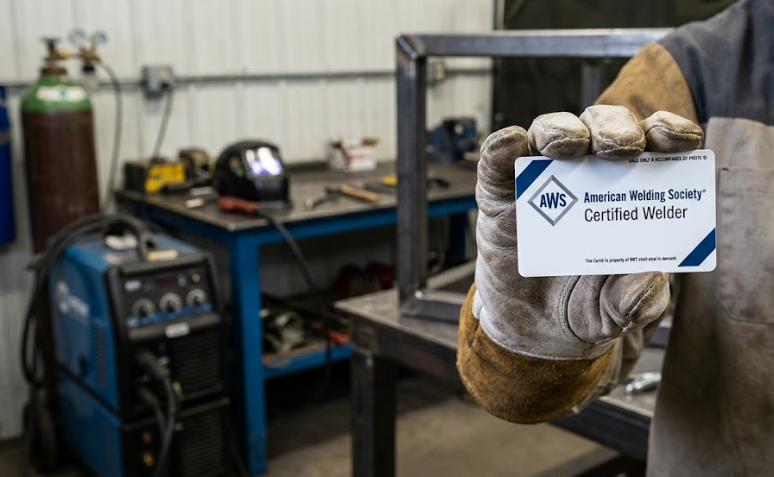
The AWS Certified Welder (CW) credential is a performance-based qualification issued by the American Welding Society confirming that a welder can produce welds meeting specific quality requirements under a Welding Procedure Specification (WPS). It’s “transferable,” meaning it follows you from employer to employer without retesting — which distinguishes it from an employer-specific qualification that only covers work for one company. The CW program covers welding processes used in structural steel, petroleum pipelines, sheet metal, and chemical refinery industries, and tests are administered at AWS Accredited Test Facilities (ATFs) nationwide.
One terminology distinction worth clearing up before going further: in welding, “qualified” and “certified” are not interchangeable. A qualified welder has passed a performance test administered by or for a specific employer under a WPS — valid for that employer’s work. A certified welder has passed the same kind of performance test at an independent AWS-accredited facility, producing a credential that’s portable across employers. If your goal is a credential that travels with you, the AWS CW program is the path.
How Many Hours Does It Take to Become a Certified Welder?
This depends entirely on which path you take to build the skills before the test — the certification itself is a performance exam, not a course with a minimum hour requirement.
Fast-track programs run as short as 120 hours of focused instruction, designed specifically to build the skills needed to pass AWS certification in the shortest viable timeframe. Several community colleges and training centers run these programs over 6–8 weeks.
Trade school certificate programs take 6–18 months and cover a broader range of processes, positions, and theory alongside the hands-on skills needed for certification.
Apprenticeships are the longest path — assuming no previous experience, AWS Certified Welder apprentices may need approximately 3–4 years to complete the program. The advantage is that apprenticeships are paid from day one and combine instruction with real production work rather than school-only practice.
Self-taught or on-the-job experience has no required hour count at all. The AWS CW program is open to anyone who can pass the test, regardless of how they learned — welding school, apprenticeship, military training, or years of self-directed practice are all equally valid preparation.
How Long Does It Take to Become a Certified Welder?
For the credential itself, the answer is straightforward: the test is scheduled through an ATF, the weld is evaluated, and the result is pass or fail. The certification can be earned in a single test session once you’re ready for it.
The real timeline question is how long it takes to build the skills to pass. For a complete beginner targeting a basic flat-position plate test:
- A 120-hour fast-track program is a realistic minimum preparation timeline.
- Most trade school programs schedule certification testing toward the end of a 6–12 month certificate program.
- Experienced welders transitioning to a new process or position can often prepare for and pass a specific certification in weeks of focused practice.
The AWS certification itself must be maintained — it requires renewal every six months through documented continued welding practice or retesting, and tests cost $35–$50 per position at an ATF.
How Hard Is It to Get Welding Certified?
It depends almost entirely on which specific test you’re attempting. The AWS CW program has no prerequisites because the difficulty is built into the position and process combinations being tested — a basic flat-position (1G) plate test in MIG welding is genuinely achievable for a prepared beginner, while a 6G fixed-position pipe test is widely regarded as one of the most demanding performance tests in the trade.
Several factors affect pass rate:
Position — flat position is the most forgiving since gravity helps maintain the puddle. Vertical-up, horizontal, overhead, and especially 6G pipe combinations add progressive difficulty and reduce pass rates accordingly.
Process — the process you test on affects difficulty. Testing on SMAW (stick) requires mastering arc striking and consistent arc length simultaneously with travel speed, while GMAW (MIG) removes the arc-length management variable.
Preparation quality — practicing specifically in the position and process being tested matters far more than total hours welded. Flat-position MIG practice doesn’t prepare you for a vertical stick test.
Test-day nerves — knowing you’re being evaluated changes performance for many welders. Running the actual test configuration repeatedly under realistic conditions is better preparation than more general practice.
The Path to AWS Certification Step-by-Step
- Identify which process and position to certify in first. Target the certification most relevant to the work you want to do — structural steel welders typically test under AWS D1.1, pipeline welders target API 1104.
- Build the specific skills for that test configuration. Practice the exact position, process, electrode type, and joint design you’ll be tested on, not general welding skills.
- Find an AWS Accredited Test Facility near you. The AWS website maintains a current ATF directory — as of January 15, 2026, all applications are submitted online through the My AWS Portal rather than paper applications.
- Schedule and take the test. Tests cost $35–$50 per position at most ATFs. Bring current documentation of your welding practice if required.
- Maintain the certification every six months. AWS CW certification requires documented continued practice in the same process and position or retesting — this isn’t optional if the credential is to remain active.
Can You Make $100,000 a Year Welding?
Yes — with the right certification path and specialty. Certified welders average $24–$31 per hour, a meaningful step above the general workforce median, but the path to six figures usually requires more than the baseline CW credential alone. The clearest routes:
6G pipe certification opens pipeline work where the combination of base wage, overtime, and per diem genuinely pushes working income toward six figures for those who follow the work. Pipeline journeymen under the Pipeliners Local 798 scale earn $52.07–$53.00 per hour base, plus $165 per day per diem.
AWS Certified Welding Inspector (CWI) shifts a welder into quality assurance roles paying $70,000–$110,000, with a documented average salary jump of $30,000 or more compared to general welding roles.
Union membership adds a 25–40% premium over non-union rates regardless of specialty, making it one of the most reliable pay multipliers available without additional certification.
Why Do Welders Not Live Long?
There’s no solid evidence that welding itself shortens life expectancy. The long-term health risks associated with the trade — elevated risks from fume exposure and UV radiation — trace directly to inadequate protective equipment use, not the work itself. Welders who consistently use respirators, ventilation, and correctly shaded helmets largely avoid the outcomes this persistent myth describes. For anyone starting a welding career, treating PPE as non-negotiable from day one — not optional on quick jobs — is the professional habit that matters for long-term health.
Common Mistakes When Pursuing Welding Certification
- Practicing the wrong configuration for your target test — hours of flat-position MIG welding don’t translate directly to a vertical stick certification test.
- Not understanding the maintenance requirement — letting an AWS CW certification lapse by missing the six-month documentation requirement requires retesting to reinstate.
- Confusing employer qualification with AWS certification — an employer-specific weld test doesn’t produce a portable credential; only an ATF test produces a transferable AWS CW certification.
- Targeting the most impressive certification first — attempting 6G pipe certification before solid fundamentals are established makes the test harder than necessary and can be discouraging.
- Forgetting that the test fee is per position — planning to certify in multiple positions means budgeting for multiple test fees, not one.
Wrapping Up
Becoming a certified welder through the AWS CW program is more straightforward than most people expect — no prerequisites, no minimum experience, and a purely performance-based test that rewards specific preparation over general welding hours. The challenge is building the right skills for the specific position and process you’re targeting, maintaining the certification every six months once earned, and using it as a foundation for the specialized credentials that open the highest-paying roles.
Frequently Asked Questions
How many hours does it take to become a certified welder?
There’s no minimum hour requirement to sit the AWS CW test — the credential is purely performance-based. Fast-track programs run as short as 120 hours, trade school certificate programs take 6–18 months, and apprenticeships assume 3–4 years for those starting with no prior experience.
How long does it take to become a certified welder?
The test itself can be taken in a single session once you’re ready. The realistic preparation timeline ranges from several weeks for experienced welders targeting a new position to 6–18 months through a formal trade school program for complete beginners.
How hard is it to get welding certified?
Difficulty is almost entirely determined by which position and process you’re testing on — a flat-position plate test is genuinely achievable for a well-prepared beginner, while a 6G fixed-position pipe test is one of the most demanding tests in the trade regardless of experience.
Can you make $100,000 as a welder?
Yes — 6G pipeline certification, CWI inspection credentials, union membership, and offshore or pipeline work are the most reliable paths to six-figure welding income, though a basic CW credential alone typically puts you in the $24–$31/hour range rather than immediately at six figures.
Why do welders not live long?
There’s no solid evidence welding shortens life expectancy. Long-term risks come from inadequate fume and UV protection, not the trade itself — consistent PPE use from the start of a career largely prevents the health outcomes this myth is based on.